Watch the presentation below about question tags to recap what you've learned this week:
Follow these links for more practice on question tags:
http://www.ihbristol.com/free-english-exercises/test/esol-smc-question-tags
http://www.englisch-hilfen.de/en/exercises/questions/question_tags3.htm
http://www.englisch-hilfen.de/en/exercises/questions/question_tags2.htm
http://www.englishgrammarsecrets.com/questionstags/menu.php
http://www.usingenglish.com/quizzes/233.html
http://www.englishexercises.org/makeagame/viewgame.asp?id=2100

Tuesday, 14 October 2014

Wednesday, 24 September 2014
Phrasal Verbs
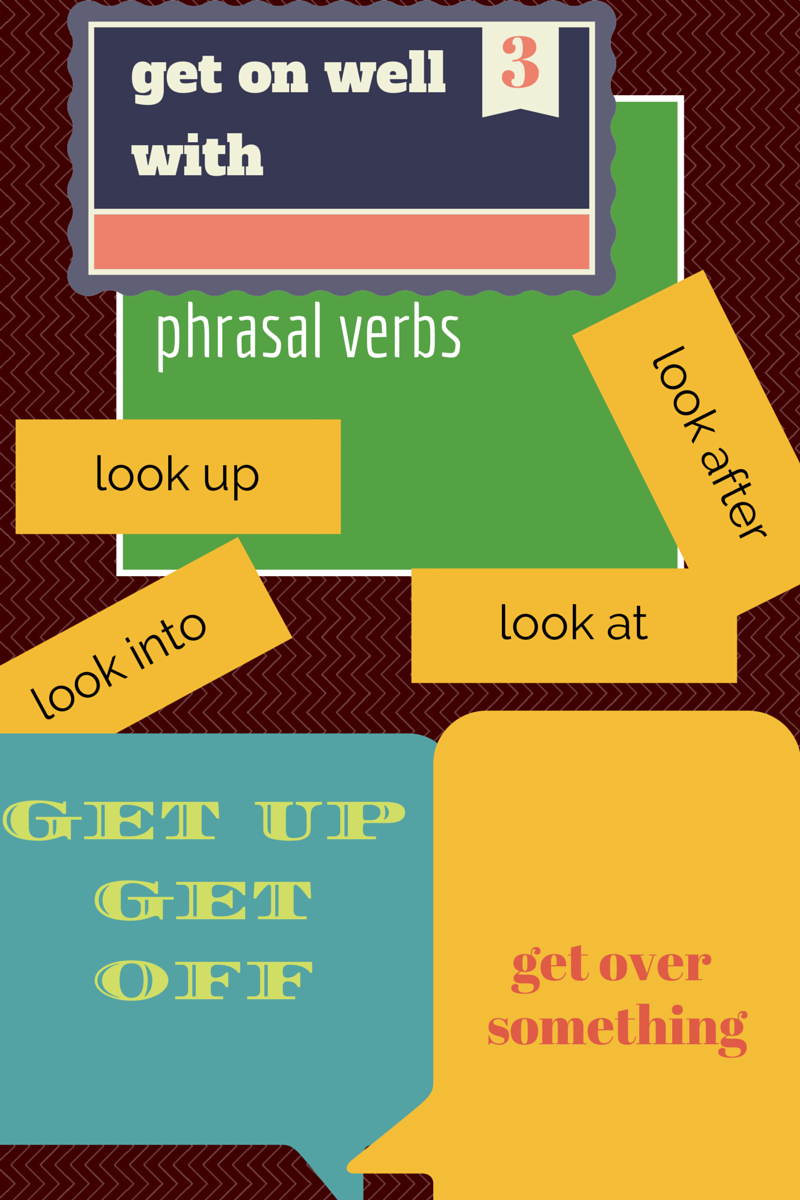
Phrasal verbs are everywhere. You wake up in the morning. Then, you get up and put the make-up on (if you are a girl!). You get out of the house and hop on a bus because you want to get to work on time. You write up emails and go to meetings. Finally, after a hard day's work you come back home, put the TV on or listen to the radio. You just need to relax! Phrasal verbs overload!
There are a couple of things that you need to know about phrasal verbs:
1. They always consist of a verb (e.g. put) and a preposition (e.g. on) or a particle (e.g. away)
2. They can also have an object (e.g. 'it', 'her', 'the word') either in the middle or at the end (e.g. put it out, phone her back, look the word up // look for it, look after her, look for the word).
3. The position of the object can sometimes change (e.g. Can you fill in this form. = Can you fill this form in. // I'm going to throw away these old shoes. = I'm going to throw these old shoes away.)
4. They can have literal and non-literal meaning. Take the following sentence.
Yesterday, I picked up a girl.
Literal meaning is this:
 |
| You actually lifted a girl off the ground. |
 |
| You chatted to a girl and she liked you. |
5. They are best learn when you see/listen to them in context. It's pointless trying to memorise them because they are just too confusing!
In order to get to grips with all this phrasal verbs business, try the following exercises:
Online game (easier)
Select correct particle/preposition (difficult)
Select correct particle (quite difficult)
Different games according to the verb
Monday, 21 July 2014
Punctuation- what's difficult about it?
It seems that everyone knows the rules of punctuation. You know that a full stop is at the end of the sentence and a comma separates two independent clauses or words in a list. So what's a big deal? Why so many students get it wrong?
The importance of punctuation cannot be overestimated. Why? Because it changes the meaning of the sentence, e.g.

And it makes the reading of texts easier.
can you imagine that there is no full stops commas apostrophes question marks exclamation marks and any other marks in the text you are reading you will find that it is very difficult to follow the text because you dont know when one sentence finishes and the other one starts and of course there are no capital letters to guide you though what a mess
To practise the use of punctuation and capital letters, please follow the links and do the exercises:
Thanksgiving
Valentine's Day
St David's Day
BBC games
The importance of punctuation cannot be overestimated. Why? Because it changes the meaning of the sentence, e.g.
And it makes the reading of texts easier.
can you imagine that there is no full stops commas apostrophes question marks exclamation marks and any other marks in the text you are reading you will find that it is very difficult to follow the text because you dont know when one sentence finishes and the other one starts and of course there are no capital letters to guide you though what a mess
To practise the use of punctuation and capital letters, please follow the links and do the exercises:
Thanksgiving
Valentine's Day
St David's Day
BBC games
Tuesday, 17 June 2014
Connectors vs Conjunctions
When you google the word 'connector', this is what comes up:

The main feature of connectors is that they DO NOT join clauses within a sentence. They join IDEAS, i.e. they join separate sentences rather than clauses within one sentence.
which, of course, has nothing to do with learning English, or has it? On the surface, it may not be so obvious, but connectors in language have the same function as connectors shown above- they are necessary to link pieces of a greater whole. In language, they help to create a cohesive whole of your longer piece of writing or a longer piece of speech. In practical terms, they are very important for your speaking and writing exam.
As seen above, there are different connectors- they have various shapes and they link different parts within a unit. Similarly, connectors in language have different functions. The table below sumarises some connectors and their functions:
 |
| *Adapted from Advanced Grammar in Use by M Hewings |
For further practice, please use the following websites:
So, what are conjunctions? Well, when I google them, the following images appear, meaning that conjunctions are uniquely linked to language and they don't have any other functions, like in the case of connectors.

*** Be careful with 'after', 'before' and 'so' as they can be both connectors and conjunctions.
Conjunctions, in contrast to connectors, link two clauses within a sentence. They DO NOT link separate sentences, that is why, for example, you cannot start your sentences with 'because' as it has to be attached to another part of the same sentence. On the other hand, conjunctions share the same functions as connectors, i.e. they can introduce contrast, comparison, addition, etc. within a sentence. Have a look below at the revised table of conjunctions and connectors:
 |
| *Adapted from Advanced Grammar in Use by M Hewings |
To clarify what conjunctions do, have a go at the following activities:
Tuesday, 10 June 2014
Reading exam- How to pass it?

What comes to your mind when you think of your reading exam? Do you feel confident that you'll pass? Do you have a secret method of passing an exam? Maybe you dread it altogether because you are afraid that there will be words that you don't understand?
Here are a couple of tips that will help you to feel more confident before your reading exam.

Know what to expect. Doing practice papers is an invaluable source of information. Not only do you get an idea of the level of difficulty of the exam, but also the type of tasks that you can expect.We did some practice tests in class, but for the future, if you don't/can't practise in class, don't forget that examining bodies (like City and Guilds) put practice tests on their websites which you can download and do in your own time.
For your City & Guilds Literacy test you already know that there are two types of tasks: multiple choice questions and open questions. The open questions require a specific number of answers. If you go over the limit, even if the extra answer that you provided is correct, you will still be marked down for not following the instructions. Please remember about it during your real exam.

Read the questions first. This will help you to understand what the texts will be about. You can also underline key words which you will later look for in the text. Make a mental note of how many questions there are in total so that you manage your time effectively during the real exam.

Use reading techniques. Reading in detail and translating words that you don't understand is the WORST thing that you can do. Many students, especially at higher levels, are scared of not understanding each and every word in text, just in case they need it to answer questions. While it might be true for a small number of questions, you will be able to answer most of the questions just by skimming and scanning.
Skimming is when you read the text quite quickly, picking up the key words. The main idea behind this reading technique is to give you general meaning of the text, so called gist. That is why it is important to underline key words in questions to the text as you will most likely find the same words in text when you skim it.
Scanning is when you only look for a particular piece of information. For example, if a question requires you to provide a year/time/telephone number, don't bother reading the whole text. Just look around for a number and you'll find the information you need much quicker.
Reading in detail is the last thing you do. If you stumble across a question that you have problems with, you have no other choice but to read in detail. This is fine as long as you don't spend too much time on it. Try to leave difficult questions to the end.

Look at the whole page. Sometimes the text in your exam will be a screenshot of a webpage or a leaflet. They contain pictures, different fonts, tabs, etc. which also give information. So, don't concentrate purely on the text itself; sometimes the answer to the question might be in a picture or a caption.

Stay calm and carry on! Don't get too stressed if the topic of the exam is difficult for you. Just do whatever you can and follow the instructions. There is always a retake ;)
GOOD LUCK!
Monday, 28 April 2014
Skills versus personal qualities
Looking for a job is a big task! That is why it is especially important to understand job adverts. Apart from typical information like the name of the company, duties and responsibilities of the job, qualifications and experience required, job adverts sometimes specify skills and qualities that the candidates are required to have. But what's the difference between skills and personal qualities?
Look at some examples below. The words underlined in red refer to skills whereas the words underlined in green refer to personal qualities. Have a think what the difference is between them.


Look at some examples below. The words underlined in red refer to skills whereas the words underlined in green refer to personal qualities. Have a think what the difference is between them.
Generally speaking, the difference between skills and personal qualities is that skills refer to something that we can do while personal qualities refer to the way we are, our character. We can also say that we can get better at our skills, for example, the longer we use computers, the better computer skills we have. On the other hand, our personal qualities remain the same throughout our lives, for example, you can be a friendly person by nature. We can't really become 'friendlier' in time.
Sometimes, however, the distinction isn't as clear-cut. Let's think about the word 'persuasive'. According to the Oxford Advanced Learner's Dictionary, this word means 'able to persuade somebody to do or believe something', which would imply that it is more of a skill. This sort of skill would be sought after in a call centre where, as a representative, you often have to sell things. Let's say you have to sell home insurance. The more insurance policies you sell, the stronger persuasive skills you have. And of course, as you have to practise selling them every day, you become better at persuading people and you sell even more policies. In other words, 'persuasive' is a skill because you get better at it in time.
On the other hand, some people are naturally persuasive. Maybe it's their tone of voice or maybe certain words that they use. Regardless of the reason, people tend to give in to their persuasiveness. That is why some of the call centre workers achieve remarkable results in selling insurance whereas other people just can't sell any insurance policies at all. So, we can say that 'persuasive' is a bit the way you are. You can't just learn it because otherwise all call centre workers would sell the same amount of policies.
Below, there is a list of skills and personal qualities that the employers look the most in their future employees. Maybe you can use some words in your CV or an application form?
Wednesday, 9 April 2014
Formal letters- how to plan & write them?
From time to time we are required to write a formal piece of writing, usually a letter. We can write a covering letter to support our job application form or a letter of complaint when we are dissatisfied with service that we received. Regardless of the type of letter that we need to write, it's always good to have a plan.
Let's look closely at the following situation:
You have a direct debit of £35 set up with your mobile phone provider to pay for your phone bill every month. Last month, £335 was taken from your account and as a result you went £200 overdraft. You need to write a letter of complaint to the bank manager of your bank explaining the situation and suggesting resolution to the problem.
First, we need to have a plan for our letter. There are a few ways in which you can plan your writing. Here, you have got four examples: a list, a writing frame, a flow chart and a mind map. All of the examples show various ways in which you can plan the letter above.
List


by mariolahejduk
So, below you have an example of how we could correct the draft. Please bear in mind that this might not be the final version yet. You might need more editing before you arrive at a version that you are happy with.

Let's look closely at the following situation:
You have a direct debit of £35 set up with your mobile phone provider to pay for your phone bill every month. Last month, £335 was taken from your account and as a result you went £200 overdraft. You need to write a letter of complaint to the bank manager of your bank explaining the situation and suggesting resolution to the problem.
First, we need to have a plan for our letter. There are a few ways in which you can plan your writing. Here, you have got four examples: a list, a writing frame, a flow chart and a mind map. All of the examples show various ways in which you can plan the letter above.
List
Writing frame
Flow chart
Mind map
So once you have a plan you need to write a draft. A draft is the first version of your letter. Many students think that the first version of their piece of writing is good enough to go. That's a mistake. A draft is just a way of putting your plan into a letter-like shape but it is NOT the letter that you can send. At this stage you just need to write and not worry about the grammar mistakes or spelling problems. You will correct them later. Below, you have an example of a draft.
Once you have your draft, there are many ways in which you can improve it. Below you have a mind map which shows different aspects that need to be looked at when editing a piece of writing.
by mariolahejduk
So, below you have an example of how we could correct the draft. Please bear in mind that this might not be the final version yet. You might need more editing before you arrive at a version that you are happy with.
So now it's time to write the final version of our letter. Here's an example:
Jane
Smith
12
White Gardens
London
WS1
4QR
The Manager 22.01.14
Lloyds Bank
12 Poor Street
TS5 7RJ
Dear Sir/Madam,
I am writing to complain about an unauthorised transaction
that took place on my bank account (bank account number 44123124) on Thursday 18.01.14.
I have a direct debit set up with my mobile phone provider,
Vodafone, of £35. The amount is taken from my account at the beginning of every
month. Last week, £335 was taken from my bank account. I called Vodafone to
enquire about it but they said that they only received the usual amount. So the
problem seems to be with your system.
As a result of this mistake, I went £200 overdraft and I am
being charged an overdraft fee of £5 every day. What is more, last weekend I
could not afford my weekly shopping and I am not able to pay other bills which
are due this month. I find this whole situation very stressful and I am
disappointed with the fact that your bank allowed such situation to happen.
Can you give this matter your immediate attention? I would
like you to refund my money immediately and cancel any overdraft charges.
Yours faithfully,
Jane Smith
Remember that writing is a process. You need to start with a plan, i.e. you generate ideas and try to write them down showing relationship between them. Then, you write your ideas in sentences in paragraphs, i.e. you create your draft. Finally, you edit your work. You check for grammar, spelling and punctuation mistakes but also you add and delete sentences and you change words so that they sound more formal.
Subscribe to:
Posts (Atom)